Foolproof White Sourdough Bread Recipe
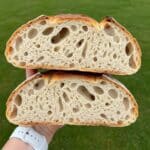
This foolproof white sourdough bread recipe guides you through the entire process from feeding your starter to baking a crusty, flavorful loaf. Perfect for home bakers wanting a reliable method for achieving a tender crumb with a golden crust using natural fermentation and slow cold retardation.
- Prep Time: 12 hours (including starter feeding and resting times)
- Cook Time: 40 minutes
- Total Time: Approximately 13 hours (including cold retard of 12-36 hours, prep, and baking)
- Yield: 2 loaves 1x
- Category: Bread
- Method: Baking
- Cuisine: French
- Diet: Vegetarian
Ingredients
Scale
Starter Feeding
- 25 g sourdough starter
- 125 g water
- 125 g bread flour
Dough
- 600 g warm water
- 240 g active sourdough starter
- 1,000 g bread flour
- 20 g sea salt
- 40 g warm water
Instructions
- Feed Your Starter: The night before baking, combine 25 g sourdough starter, 125 g water, and 125 g bread flour in a jar at a 1:5:5 ratio. Let it ferment about 10 hours at 75°F/24°C until it doubles or triples, with a slightly concave top.
- Mix Your Dough: Use Maurizio Leo’s water temperature calculator to get a final dough temperature of 78°-80°F (25.5°-26.6°C). Combine 600 g warm water, 240 g active sourdough starter, and 1,000 g bread flour until a shaggy dough forms. Perform slap and folds on the counter for 1-2 minutes then cover and rest for 1 hour.
- Add Salt and Knead: After the 1-hour rest, add 40 g warm water and 20 g sea salt. Knead and do slap and folds until the dough is smooth and rubbery, working the salt into the dough. This may take a few minutes until the dough comes together fully.
- Stretch and Folds: Rest dough 30 minutes. Perform 4 sets of stretch and folds at 30-minute intervals, optionally using coil folds for gentler handling on the final sets. Maintain dough temperature between 78°-80°F by adjusting proofing environment.
- Bulk Fermentation: Allow dough to ferment until puffy and domed, about 4-5 hours at optimal temperature. Confirm dough jiggles like Jell-O and shows plenty of bubbles on bowl sides. If cooler, fermentation takes longer. Overproofing is preferred over underproofing.
- Divide and Pre-Shape: Use a bench scraper to divide dough into two pieces for two loaves (or skip if making one loaf). Shape into rounds using a candy cane motion then let rest for 30 minutes.
- Final Shape: Use the caddy clasp technique to shape dough. For batards, fold like a book and place into floured bannetons, pinching seams closed. For boules, do a double clasp and tighten the round before placing in bannetons.
- Cold Retard: Cover bannetons and refrigerate overnight for 12-36 hours but do not exceed 96 hours to develop flavor and improve dough handling.
- Score and Bake: Preheat oven to 450°F (230°C) with Dutch ovens inside. Transfer dough to parchment or sling, score the surface, and place in Dutch ovens. Optionally add 1-2 ice cubes for crust blistering. Bake covered for 25 minutes, then uncover and bake an additional 10-15 minutes until golden brown and internal temperature is 205-210°F (96-99°C). Cool on wire rack at least 90 minutes before slicing.
Notes
- Use Maurizio Leo’s water temperature calculator for accurate dough temperature.
- Optional inclusions like nuts or seeds can be added during second stretch and fold (350-400 g for two loaves).
- Dough temperature is critical: keep between 78°-80°F (25.5°-26.6°C) during fermentation for best results.
- Resting times and proofing can vary depending on ambient temperature.
- Cold retard develops flavor and improves dough texture—do not exceed 96 hours.
- Cooling bread completely before slicing ensures proper crumb texture and moisture balance.
Keywords: white sourdough bread, sourdough recipe, artisan bread, homemade bread, natural fermentation, cold retard bread, no-knead sourdough, baking bread
Find it online: https://nataliereeve.com/foolproof-white-sourdough-bread-recipe/